Have You Found Leadership in the Strangest Places?

Showing posts with label General. Show all posts

Leadership and Guide Dogs

Wednesday, December 9, 2009
I was re-reading an old Ken Blanchard article, and came upon this passage, which made me smile. He is referring to the training of Guide Dogs:

Trainers take two kinds of dogs out of the program - the completely disobedient and the completely obedient. You'd expect the first group to be dismissed, but why the second? Because the only dogs trainer's keep are the ones that will do whatever the master says unless it doesn't make sense. Imagine letting dogs think! And yet, it would be a disaster if a Seeing Eye Dog and his or her master were waiting on the corner and the master said, "Forward." The dog, seeing a car speeding in their direction, shrugs his shoulders and thinks to himself, "This is a real bummer" as he leads his master into the middle of the street. Frontline / customer-contact people are asked to do that all the time - do what they're told, follow policy, even if it doesn't make sense for the particular situation (p. 24).

If your team is full of only completely obedient people, who do only what they're told, then get ready to be run over by a car. Thinking critically, providing feedback, and challenging ideas are all qualities of an effective leadership process.

This passage also reminds me that those we lead sometimes know where to take us, how to get us there, and when to start. Sometimes it's best to trust them, and get out of the way.


Source: Blanchard, K. (1998). Servant-leadership revisited. In L.C. Spears (Ed.), Insights on leadership (pp. 21-28). New York, NY: John Wiley and Sons.

Deficit of Leadership?

Sunday, October 25, 2009
David Gergen argues in U.S. News and World Report that we have a national deficit of leadership. He focuses almost exclusively on political leaders, yet claims the scope of the problem is national. A link to the article is below. Mr. Gergen makes some bold statements, including:

"It was nearly four decades ago that John Gardner first observed that at the founding, with a population of 3 million, the republic spawned a dozen world-class leaders—Washington, Jefferson, Franklin, Adams, Madison, and Hamilton among them—but today, with a population nearly 100 times that, we struggle to produce even one or two."

That's a fairly subjective statement. What does it mean to be "world-class?" What does one have to accomplish to meet that standard? If it requires the founding of a nation, then it's no wonder we've had so few.

Mr. Gergen also points out that "the blogosphere and 24-hour news channels that feature extreme voices and manufacture artificial controversies" provide a greater challenge to leaders today than in the past. He reminisces about the good old days when everyone was civil and the tone was positive. These would also be the days when leadership was uni-directional and ordinary folks had very limited chances to question authority. The internet has provided a chance for followers to influence leaders - and thus become leaders themselves in the process. Cable news networks can provide a lot of negativity, but can also provide more public accountability to leaders, which there was less of in the good old days. Perhaps we'd consider more leaders today world-class if we knew as little about them as citizens knew about their leaders before cable and the internet.

So - Mr. Gergen - perhaps we've seen a deficit in traditional, top-down, positional leadership. But, perhaps we've also seen a rise in innovative, bottom-up, influential grassroots leadership. I don't have any empirical evidence to support this, but my sense is that while national leaders might be failing, local folks who work through nonprofits, activist groups, and civic organizations may be leading more strongly than ever. Where you see a deficit, I think I see a shift.

Here is Mr. Gergen's article.

Cowboy Humility

Wednesday, October 21, 2009
I came upon this old cowboy proverb today:

"If you get to thinkin' you're a person of influence, try orderin' somebody else's dog around"

I love the analogy in this proverb, and the many messages drawn from it. Leadership really is contextual. Just because we lead in one arena doesn't necessarily mean will be effective in another. Similarly, just because we have to withdraw a bit in one setting doesn't mean we can't be a full leader in another. This proverb also matches up with the emergent belief that leadership is about the process and not about the person.

The proverb also observes the power of being humbled. When in a position of power, we may often get caught up in our own influence. I think of star athletes who are often chided after a poor performance for "believing their own press clippings." Or, the high-powered executive who comes home and gets completely flummoxed by his teenage daughter.

If we think about the context, environment, and process we are in before we think about ourselves, leadership may come more naturally. It may also keep us more humble.

Vanity and Leadership

Tuesday, October 6, 2009

I’ve read some columns and listened to political pundits over the weekend discuss at length whether or not President Obama is narcissistic and if that’s negatively affecting his impact as a leader. Conservative columnist George Will discussed this issue in the context of Obama’s (and the first lady’s) speeches to the International Olympic Committee in Copenhagen. In his column, Will remarks that: “In the 41 sentences of her remarks, Michelle Obama used some form of the personal pronouns ‘I’ or ‘me’ 44 times. Her husband was, comparatively, a shrinking violet, using those pronouns only 26 times in 48 sentences. Still, 70 times in 89 sentences was sufficient to convey the message that somehow their fascinating selves were what made, or should have made, Chicago's case compelling.” A rebuttal to Will's column is here.


President Obama’s self-confidence (described as vain, narcissistic, egotistical, arrogant) has come up repeatedly as a criticism since he took office. One of his opponents in the election, Sarah Palin, also faced similar criticism, being labeled as a “diva” by even those on her own side. She has even been accused of having a narcissistic personality disorder.

Narcissism is mostly used in the negative – as a way to describe someone who is obnoxiously self-centered. Although, if kept in check, it can be seen as a positive. Emily Yoffe, in a column on Slate.com recently wrote about narcissism and noted that it “is used to describe a quality that comes in three gradations: a characteristic that in the right amount is a normal component of healthy ego; a troublesome trait when there is too much; and a pathological state when it overwhelms a personality.”

I don’t know if the commentary about Obama or Palin is fair. It’s hard to really know anyone in this world of soundbites, instant reaction, and attack-style politics. I also don’t think they’re very different from their colleagues on capital hill. Most politicians echo, through their actions, the famous words of NFL star Chad Ochocinco: “I love me some me!”

However, it got me wondering about the vanity and its role in leadership. (By the way, I tend to use the words vanity, ego, and narcissism interchangeably, although I’m sure there are some subtle differences in those concepts).

Do leaders tend to have large egos? Probably. It takes a lot of self-confidence to step forward and assume the risks of leadership.

Does a leader have to have a large ego? No. One way to examine is something is necessary or significant as a leadership quality is to also understand the opposite trait. The opposite of vanity is humility. Some of the finest leaders, those that Jim Collins refers to as “Level 5” leaders in Good to Great, are exceptionally humble.

If you had two leaders, one of them vain, and the other humble, who has the greater chance for success? It depends on a myriad of other factors of course, but I tend to believe that the vain leader would have a greater impact immediately, whereas the humble leader would have an impact that lasts longer. Both kinds of leaders can be respected, but I wonder if the legacy of a humble leader becomes stronger by the sheer fact that we just like them more.

Should leaders nurture their ego? Perhaps - if it helps them exert influence in a positive way for the betterment of the organization. Pete Hall wrote a nice article for Education World on this topic. He states “Simply put, since we acknowledge that leaders who are charismatic and self-confident (the politically-correct term for possessing a strong ego) are likely to be effective in their leadership, then we ought to cultivate those traits.”

Should leaders keep their egos in check? Definitely. As a society, we value strength and confidence in our leaders. However, we despise unnecessary arrogance or self-grandeur – especially in our elected public servants.

Thus, in summary, I think all leaders exist on a continuum of vanity and ego. Those who stay in the middle of the continuum, or more towards the less extreme end, tend to get rewarded. Those who drift farther towards the vain or narcissistic end tend to get ridiculed and criticized.

That’s enough rambling on the subject. I’d love to have your thoughts.

Leadership in the Story of a Rock Song

Monday, September 28, 2009
Joseph Rost wrote a very influential book years ago entitled "Leadership for the Twenty-First Century." For anyone interested in the progression of leadership thought and study over the years, this book was a masterwork. Rost, through his extensive research and powerful tone, made perhaps the most convincing argument to date that leadership was not a top-down proposition. Rather, Rost's definition says that leadership is an influence relationship among leaders and followers who intend real changes that reflect their mutual purposes. Defining leadership as a relationship means that both leaders and followers are doing leadership. This flies against the typical paradigm of of leadership being projected only from a leader to a follower. The arrow can go both ways, according to Rost.

Now consider the rock group Pearl Jam, one of the most successful musical groups in modern times. In their profile on the VH1 show "Storytellers," frontman Eddie Vedder told a story about Pearl Jam's most popular hit song - "Alive." In his story, Vedder essentially describes Rost's definition of leadership. Vedder tells about how the audience for Pearl Jam's live shows, through their collective influence, forever changed for him the interpretation of the song. The band on the stage, and the audience in the stadiums, were practicing leadership with each other. The story is powerful, and worth a few minutes of your time:


I doubt Rost and Vedder ever encountered each other or each other's work. Rost might have found a Pearl Jam song to be a strange place for his ideas - but leadership is often found in the strangest places!

By the way, if you are not familiar with the song, here is a video with both the story above and their performance of the song.

Imagine Leadership

Monday, September 21, 2009
My friend Corey White found this video. I love the messages and the way in which the visuals tell the story. Here is the video's description from YouTube:
Nitin Nohria and Amanda Pepper of Harvard Business School's Leadership Initiative collaborated with XPLANE to create this video in order to generate a discussion of the value and importance of leadership to address some of societys most pressing problems.

"It is my desire to inspire people of all ages and social demographics to think about leadership on a broad level, contemplate what it means to them and what individual impact they can have when it comes to leading," says Nohria.
Enjoy!


Sivers/Vonnegut: Drama and Leadership

Tuesday, September 15, 2009
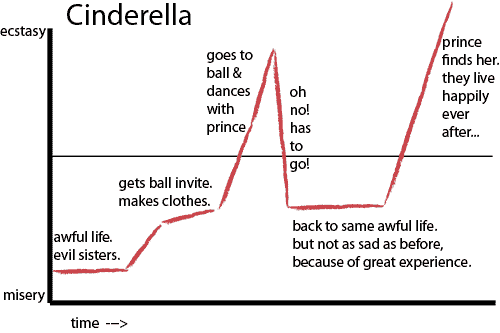
I read a great piece by blogger Derek Sivers, who recalled a Kurt Vonnegut lecture he attended. The talk focused on why people often need and seek out more drama in their lives. Vonnegut's premise is fascinating in that he links that need for drama with the familiar arc of stories we hear in all types of places. Sivers recreates some charts that Vonnegut used to make his point, including this one:


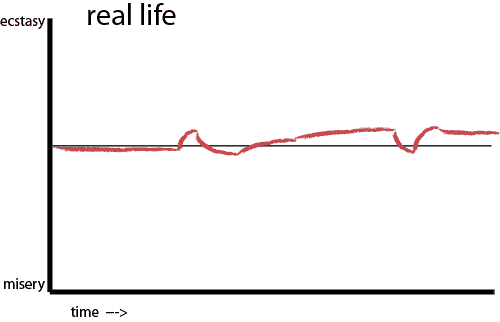
Vonnegut contrasted a common story like this with what happens in real life, which has far fewer dramatic ups and downs.


His point is that people often actively try to make that line move up or down so as to mirror the heroic and uplifting stories they have been exposed to. Thus, we frequently create (often only in our minds) our own dramatic moments, with the intention of a fairy-tale ending.

When it comes to leadership, I think this can be true as well. Especially in regards to heroic leadership. The stories of leaders we grow up learning about often follow familiar themes:

Leader is born, greatness is evident early -> leader faces some hardship in life -> with guts and determination, the leader emerges stronger than before -> the leader has a pinnacle moment (typically a rousing speech) that inspires others -> leader achieves good for mankind and is regarded a hero.

These stories of leadership can be what limits some from even engaging in leadership. Some may go on to do great things because of the inspiration of these stories, but others may find to great of a disconnect with their own experiences. If I haven't had some unusual life experience, or I cannot give a stirring speech, then what can I offer?

If we pulled back the curtain on some of these stories, we might see things that are far more common. Great leaders often have family or friends that help build their self-confidence and position them for great moments. Thus, hardly anyone does it alone. Many leaders come from privileged backgrounds - or relatively mundane ones. The achievements of most effective leaders are due to the hard work we never see - not the breathtaking speeches we do. Lastly, leaders often find themselves in "moments of greatness" by sheer accident. The heroic pilot who landed the plane in the Hudson River certainly didn't plan for greatness!

I reflect back on Martin Luther King, Jr. and his story. It's a wonderful story that needs to be told over and over again. But the story of those who stood alongside him - who led from the background - are the stories we need to hear more of. Those are the heroes most of us can connect with.

Kudos to Derek Sivers for a thought-provoking piece!

Breaking Decorum

Thursday, September 10, 2009
The internet and media have been buzzing with outrage about U.S. Representative Joe Wilson's outburst at President Obama's speech last night.

For instance, Rochelle Riley of the Detroit Free Press: "Joe Wilson didn’t insult the president. He insulted America. And every one of us deserves an apology, too."

First of all, count me among those who are surprised that breaking decorum in the halls of congress is such a hot-button issue. But, I'm aware of the ultra-political environment we're in and Mr. Wilson is going to get plenty of flack for what he did.

This got me thinking about the whole idea of "decorum." Decorum is the norm, the standard, the way things are supposed to be. It's one of those things that society determines collectively, based on past traditions and well-regarded practices. Most of the time, decorum is linked with things that are polite or civil.

This is all well and good, and I welcome decorum in my life. Although I must admit that I resist the term, since it makes me think boring, stuffy, and ordinary (imagine the town elders from Footloose). Mr. Wilson's outburst certainly broke decorum, as defined above. My read is that his emotions truly did get the best of him. I find it hard to despise someone like that, especially if they recognize it and apologize for it - which he did.

This post isn't about Joe Wilson. His act just got me thinking more broadly about decorum and leadership.

The leadership question is, when and how often should we break decorum? In other words, when is it appropriate to challenge the status quo, break away from convention, and go with our gut instincts about what's right?

I wonder if our regard for decorum sets us up for groupthink or the avoidance of conflict. We push against those who break decorum with our sighs, nasty looks, rolled eyes, and laughter. We isolate them, talk about them behind their backs, and give them few chances to respect decorum again. Why do we gasp when someone breaks decorum? What are we afraid of?

Many of our most treasured heroes became that way because they found the right time to break decorum. In your practice of leadership, when was the last time you did?

Those organizations that struggle might be bound too much by decorum. It can inhibit creativity. People may be more willing to hide emotions and opinions in such an environment. Maybe we're just too polite with each other.

I'm probably making too much out of this, but I just can't help it sometimes. I appreciate decorum, and it serves us well. I just wonder if more often than we realize, a well-intentioned person who breaks decorum, serves us better.

Mali (and Roberts) on Speaking with Conviction

Tuesday, September 1, 2009
One of my mentors, Denny Roberts, who writes a blog entitled "Pursuing Leadership," introduced me to the Taylor Mali video below. Denny's brief reactions are insightful (as usual). You can read his post here.

Here is the video:

What About Work Ethic?

Friday, August 28, 2009
If feadership and social change are hard work, we might be in trouble. Here is a very intriguing article from the City Journal. It's one of the best I've read recently (although it's way too long). Do you agree with the author? Have we lost the work ethic this nation was built upon? Or, does work ethic just show up differently? At first read, I agree with the author.

Here's a good quote: "In the wake of the market crash, our national discussion about how to fix capitalism seems limited to those who believe that more government will fix the problem and those who think that free markets will fix themselves. Few have asked whether we can recapture the civic virtues that nourished our commerce for 300 years."

The loss of those virtues have an impact on leadership, as I believe we are less willing to stick with difficult endeavors.

Another quote: "What would Tocqueville or Weber think of America today? In place of thrift, they would find a nation of debtors, staggering beneath loans obtained under false pretenses. In place of a steady, patient accumulation of wealth, they would find bankers and financiers with such a short-term perspective that they never pause to consider the consequences or risks of selling securities they don’t understand. In place of a country where all a man asks of government is “not to be disturbed in his toil,” as Tocqueville put it, they would find a nation of rent-seekers demanding government subsidies to purchase homes, start new ventures, or bail out old ones. They would find what Tocqueville described as the “fatal circle” of materialism—the cycle of acquisition and gratification that drives people back to ever more frenetic acquisition and that ultimately undermines prosperous democracies."

Lessons from a Broken Escalator

Wednesday, August 26, 2009
I love this clip (thanks to Jack Needham for sharing it with me). It brings about some interesting thoughts, including:
  • On a very basic surface-level, it portrays our over-reliance on technology.
  • How much control over decision-making have we relinquished to technology?
  • How often do paradigms of thinking get so deeply ingrained, that we'll do almost anything to cling on to them?
  • In our efforts to be wise, unique, and/or trendsetting, do we sometimes forget that many of the best solutions are the mundane and obvious ones? Just walk up the stairs!
  • Are our followers waiting for us to save them? Have we created this dependency by building escalators for them instead of stairs?

Intentional Influence

Tuesday, August 25, 2009
BusinessWeek featured a nic article about the idea of "influence" as it relates to leadership. My favorite part:
"Many leaders think influence consists of little more than talking people into doing things. It's no wonder most influence efforts start with PowerPoint presentations. But profound, persistent, and overwhelming problems demand more than verbal persuasion. Anyone who's ever tried to talk a smoker into quitting knows there's a lot more to behavior change than words.

Leaders make the same mistake when they publish platitudes in the form of Mission and Values statements, give a few speeches on why these values are crucial, and then assume their job is done."

Here is a link to the article.

60 Minutes Founder on Storytelling

Here is an article from Businessweek discussing the late Don Hewitt's (founder of 60 minutes) views on storytelling and it's connections with leadership:

The article is here.

Time Magazine: Charisma and Leadership

Sunday, August 23, 2009

Time magazine recently included an article about the role of charisma in leadership. Michael Elliot is the author. What do you think? Is charisma necessary, helpful, not necessary, or possibly problematic? Here is the article.