I love this video from Fast Company Magazine. Our workplaces have become havens for multi-tasking, and thus, potentially less productive. That seems counter-intuitive, but watch the video:
Showing posts with label Everyday. Show all posts
Showing posts with label Everyday. Show all posts


Mixing Up the Message
Friday, January 29, 2010
The next time you fly, take notice of the passengers when the flight crew is doing its usual safety talk. Most of them won't pay a bit of attention. They will continue reading their paper, talking to their neighbor, sleeping, etc. That's because the message never changes and is always conveyed in the same way. It becomes nothing more than background noise right before takeoff.
As leaders, when we communicate, we face the same problem. We may have a really compelling vision or idea, but how it is conveyed makes a difference.
The video below of a Southwest Airlines flight attendant serves as a great example of how we can get people engaged in our messages if we are willing to mix up the delivery. This can be applied to how we conduct meetings as well. If we surprise others with a new approach, we are likely to get and keep their attention.
Leadership and Guide Dogs
Wednesday, December 9, 2009
I was re-reading an old Ken Blanchard article, and came upon this passage, which made me smile. He is referring to the training of Guide Dogs:
If your team is full of only completely obedient people, who do only what they're told, then get ready to be run over by a car. Thinking critically, providing feedback, and challenging ideas are all qualities of an effective leadership process.
This passage also reminds me that those we lead sometimes know where to take us, how to get us there, and when to start. Sometimes it's best to trust them, and get out of the way.
Trainers take two kinds of dogs out of the program - the completely disobedient and the completely obedient. You'd expect the first group to be dismissed, but why the second? Because the only dogs trainer's keep are the ones that will do whatever the master says unless it doesn't make sense. Imagine letting dogs think! And yet, it would be a disaster if a Seeing Eye Dog and his or her master were waiting on the corner and the master said, "Forward." The dog, seeing a car speeding in their direction, shrugs his shoulders and thinks to himself, "This is a real bummer" as he leads his master into the middle of the street. Frontline / customer-contact people are asked to do that all the time - do what they're told, follow policy, even if it doesn't make sense for the particular situation (p. 24).

If your team is full of only completely obedient people, who do only what they're told, then get ready to be run over by a car. Thinking critically, providing feedback, and challenging ideas are all qualities of an effective leadership process.
This passage also reminds me that those we lead sometimes know where to take us, how to get us there, and when to start. Sometimes it's best to trust them, and get out of the way.
Source: Blanchard, K. (1998). Servant-leadership revisited. In L.C. Spears (Ed.), Insights on leadership (pp. 21-28). New York, NY: John Wiley and Sons.
Cowboy Humility
Wednesday, October 21, 2009
 I came upon this old cowboy proverb today:
"If you get to thinkin' you're a person of influence, try orderin' somebody else's dog around"
I love the analogy in this proverb, and the many messages drawn from it. Leadership really is contextual. Just because we lead in one arena doesn't necessarily mean will be effective in another. Similarly, just because we have to withdraw a bit in one setting doesn't mean we can't be a full leader in another. This proverb also matches up with the emergent belief that leadership is about the process and not about the person.
The proverb also observes the power of being humbled. When in a position of power, we may often get caught up in our own influence. I think of star athletes who are often chided after a poor performance for "believing their own press clippings." Or, the high-powered executive who comes home and gets completely flummoxed by his teenage daughter.
If we think about the context, environment, and process we are in before we think about ourselves, leadership may come more naturally. It may also keep us more humble.
Seeing What Others May Miss
Wednesday, September 16, 2009
I am always in awe of people who see something ordinary, and imagine something spectacular. In the process of leadership, freeing our minds can lead to unexpected outcomes.
Sivers/Vonnegut: Drama and Leadership
Tuesday, September 15, 2009
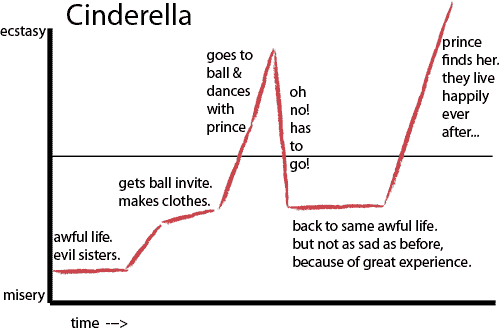
I read a great piece by blogger Derek Sivers, who recalled a Kurt Vonnegut lecture he attended. The talk focused on why people often need and seek out more drama in their lives. Vonnegut's premise is fascinating in that he links that need for drama with the familiar arc of stories we hear in all types of places. Sivers recreates some charts that Vonnegut used to make his point, including this one:

Vonnegut contrasted a common story like this with what happens in real life, which has far fewer dramatic ups and downs.

His point is that people often actively try to make that line move up or down so as to mirror the heroic and uplifting stories they have been exposed to. Thus, we frequently create (often only in our minds) our own dramatic moments, with the intention of a fairy-tale ending.
When it comes to leadership, I think this can be true as well. Especially in regards to heroic leadership. The stories of leaders we grow up learning about often follow familiar themes:
These stories of leadership can be what limits some from even engaging in leadership. Some may go on to do great things because of the inspiration of these stories, but others may find to great of a disconnect with their own experiences. If I haven't had some unusual life experience, or I cannot give a stirring speech, then what can I offer?
If we pulled back the curtain on some of these stories, we might see things that are far more common. Great leaders often have family or friends that help build their self-confidence and position them for great moments. Thus, hardly anyone does it alone. Many leaders come from privileged backgrounds - or relatively mundane ones. The achievements of most effective leaders are due to the hard work we never see - not the breathtaking speeches we do. Lastly, leaders often find themselves in "moments of greatness" by sheer accident. The heroic pilot who landed the plane in the Hudson River certainly didn't plan for greatness!
I reflect back on Martin Luther King, Jr. and his story. It's a wonderful story that needs to be told over and over again. But the story of those who stood alongside him - who led from the background - are the stories we need to hear more of. Those are the heroes most of us can connect with.
Kudos to Derek Sivers for a thought-provoking piece!
Vonnegut contrasted a common story like this with what happens in real life, which has far fewer dramatic ups and downs.
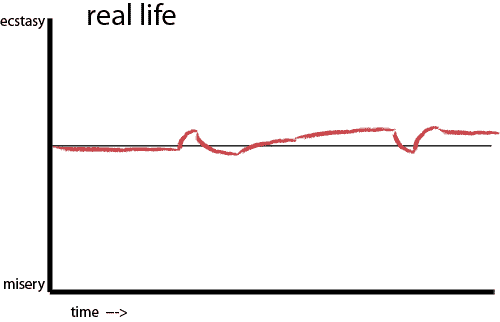
His point is that people often actively try to make that line move up or down so as to mirror the heroic and uplifting stories they have been exposed to. Thus, we frequently create (often only in our minds) our own dramatic moments, with the intention of a fairy-tale ending.
When it comes to leadership, I think this can be true as well. Especially in regards to heroic leadership. The stories of leaders we grow up learning about often follow familiar themes:
Leader is born, greatness is evident early -> leader faces some hardship in life -> with guts and determination, the leader emerges stronger than before -> the leader has a pinnacle moment (typically a rousing speech) that inspires others -> leader achieves good for mankind and is regarded a hero.
These stories of leadership can be what limits some from even engaging in leadership. Some may go on to do great things because of the inspiration of these stories, but others may find to great of a disconnect with their own experiences. If I haven't had some unusual life experience, or I cannot give a stirring speech, then what can I offer?
If we pulled back the curtain on some of these stories, we might see things that are far more common. Great leaders often have family or friends that help build their self-confidence and position them for great moments. Thus, hardly anyone does it alone. Many leaders come from privileged backgrounds - or relatively mundane ones. The achievements of most effective leaders are due to the hard work we never see - not the breathtaking speeches we do. Lastly, leaders often find themselves in "moments of greatness" by sheer accident. The heroic pilot who landed the plane in the Hudson River certainly didn't plan for greatness!
I reflect back on Martin Luther King, Jr. and his story. It's a wonderful story that needs to be told over and over again. But the story of those who stood alongside him - who led from the background - are the stories we need to hear more of. Those are the heroes most of us can connect with.
Kudos to Derek Sivers for a thought-provoking piece!

A Tribute to Everyday Leadership
Monday, August 31, 2009
This feature was produced for the Major League Baseball All-Star game, and was shown along with a ceremony honoring "everyday heroes." Stories of these kinds never get old. The piece is also compelling because it features 5 living presidents. As an advocate for the nonprofit sector, I also admire how the heroes all seem to be connected to a nonprofit organization. Enjoy...
Uniform Policies
Thursday, August 27, 2009
I saw a news report from Richmond, Indiana, which I found compelling. The school system there has started requiring uniforms for their students. I'm sure this is happening all over the country. Administrators are trying to curb inappropriate clothing in their schools, and uniforms are their answer. I was struck by how angry the parents in this news piece were. Since I view everything through the prism of leadership, here are some observations:
- Might school uniforms inhibit creative expression and encourage conformity? I couldn't locate any research on this question (please post if you know of anything). Conformity to shared values can be a good thing - but so are self-expression and wild creativity.
- Without uniforms, some students will wear inappropriate clothing - that's a fact. However, wouldn't those be opportunities to teach valuable lessons, including accountability?
- Is a lack of parental leadership the root cause?
Lessons from a Broken Escalator
Wednesday, August 26, 2009
I love this clip (thanks to Jack Needham for sharing it with me). It brings about some interesting thoughts, including:
- On a very basic surface-level, it portrays our over-reliance on technology.
- How much control over decision-making have we relinquished to technology?
- How often do paradigms of thinking get so deeply ingrained, that we'll do almost anything to cling on to them?
- In our efforts to be wise, unique, and/or trendsetting, do we sometimes forget that many of the best solutions are the mundane and obvious ones? Just walk up the stairs!
- Are our followers waiting for us to save them? Have we created this dependency by building escalators for them instead of stairs?
Starting a Movement
Sunday, August 23, 2009
Check out this video from the Sasquatch Music Festival (thanks to the team at Phired Up Productions for introducing this to me). Notice how the man's enthusiasm is contagious. How does this relate to our efforts to start movements in our organizations? Does it start with unabashed enthusiasm?
Most change movements start with an outlier - someone willing to do something extraordinary. He/she may be criticized, laughed at, mocked, or ignored. However, if he/she can convince a few others to join in (whether directly or by inspiration), it reduces the hesitancy that others may have to get involved. Thus, like this video, once the ball gets rolling, the momentum can build quickly. Who are the few people you can convince, that will push your movement forward?
Most change movements start with an outlier - someone willing to do something extraordinary. He/she may be criticized, laughed at, mocked, or ignored. However, if he/she can convince a few others to join in (whether directly or by inspiration), it reduces the hesitancy that others may have to get involved. Thus, like this video, once the ball gets rolling, the momentum can build quickly. Who are the few people you can convince, that will push your movement forward?
Subscribe to:
Posts (Atom)

 Posts

